
.jpg)
Capturing a resort is one thing. Translating the experience of moving through it on screen is another.
Hospitality content often falls into a predictable pattern: wide shots, clean edits, and a sequence of highlights stitched together. It looks polished, but it rarely reflects how the space actually feels.
For the Margaritaville project, the focus wasn’t just on capturing the environment. It was on refining how each moment connects, using AI as part of the post-production process to improve continuity, movement, and overall viewer experience.
Most video workflows rely heavily on cuts. Even when executed well, cuts interrupt momentum. They reset the viewer’s sense of space and break the natural flow of movement.
In a resort setting, where the goal is to showcase atmosphere, scale, and layout, this becomes a limitation. The viewer isn’t just watching visuals; they’re subconsciously mapping the space.
AI-assisted editing introduces a different approach. Instead of cutting between moments, it allows for transition smoothing, frame extension, and motion continuity, keeping the viewer inside the experience.
AI isn’t replacing the edit, it’s extending it.
In practical terms, it allows for more control over how footage behaves after it’s captured. Using techniques like object tracking, generative fill, and motion interpolation, editors can refine transitions and reshape how scenes connect without compromising realism.
This creates a more cohesive viewing experience, where movement feels intentional rather than assembled.
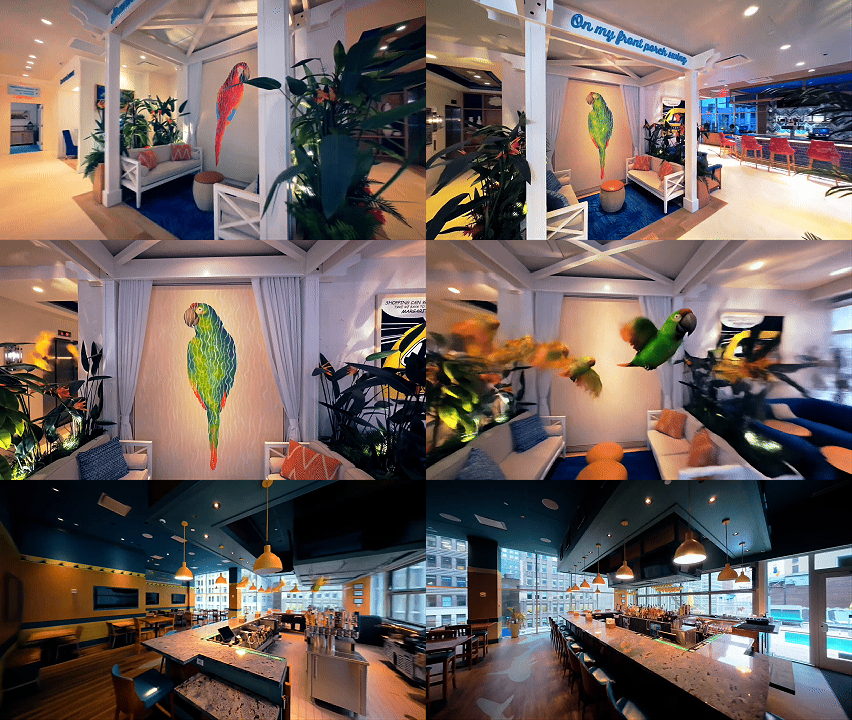
Transitions are one of the most noticeable weaknesses in traditional hospitality videos. Hard cuts or basic fades often feel disconnected from the environment itself.
With AI-assisted workflows, transitions can be built directly from the scene. Surfaces, depth, and motion are tracked and used to guide how one moment evolves into the next.
In the Margaritaville video, this approach allowed transitions to feel integrated rather than applied, maintaining visual consistency and spatial awareness.
One of the risks of using AI in video is overuse, adding elements that feel disconnected or artificial.
The focus here was restraint. Subtle motion layers and environmental interactions were introduced only where they supported the shot. The goal wasn’t to add complexity, but to reinforce movement and depth already present in the footage.
The “birds” moment is a good example. It stands out, but it doesn’t break the scene. It works because it’s anchored in the environment and timed within the natural motion of the shot.
A key challenge in AI-assisted editing is maintaining realism. Poorly integrated elements immediately stand out and reduce the perceived quality of the work.
To avoid this, every enhancement needs to match the original footage in lighting, motion, and perspective. This is where techniques like depth mapping and scene tracking become critical, ensuring that added elements behave as if they were part of the original capture.
When done correctly, the viewer doesn’t notice the AI; they notice the smoothness and clarity of the experience.
Resorts, hotels, and venues are not just visual; they’re experiential. The way a viewer moves through a space on screen directly affects how they perceive it.
By improving continuity, refining transitions, and enhancing motion, AI-assisted workflows help create content that feels more natural, more engaging, and easier to follow.
This doesn’t replace strong cinematography; it builds on it. The better the original footage, the more effective these enhancements become.
From Capture to Experience
The shift isn’t about using AI for the sake of it. It’s about improving how content performs.
Instead of delivering a sequence of shots, the goal is to create a connected experience, one that holds attention, communicates space clearly, and reflects the quality of the environment being presented.


