
.jpg)
Madame Tussauds NYC isn’t just a museum; it’s a sequence of environments designed to immerse visitors in moments, personalities, and scenes. The challenge wasn’t capturing the space it was capturing how it feels to move through it.
Traditional video breaks that experience into pieces. Cuts, angles, and static shots interrupt the natural flow. Our goal was to remove that friction entirely and replace it with a single, continuous perspective that guides the viewer through the space.
Indoor drone cinematography operates under a completely different set of constraints.
There’s no GPS stabilization. No margin for wide corrections. Every movement is manual, controlled, and intentional. In a space like Madame Tussauds filled with tight corridors, detailed environments, and high-value figures, there’s zero room for error.
This isn’t about flying, it’s about precision movement in a controlled environment.
Before a single flight, we break down the environment as a viewer journey, not a shooting location.
We identify:
The goal is to design a path that feels intuitive, as if the viewer is discovering the space in real time.
The key difference in our approach is continuity.
Instead of capturing coverage and stitching it together in editing, we build the experience through one seamless movement path. This requires aligning speed, direction, and framing in a way that feels effortless.
Every turn, elevation shift, and transition is pre-planned to maintain visual rhythm and spatial awareness.
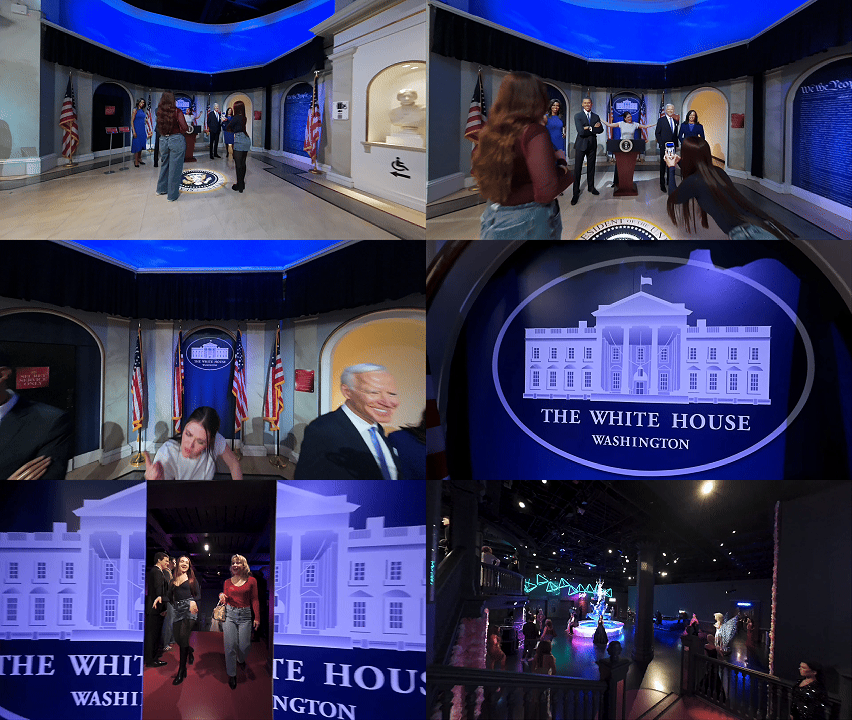
Spaces like Madame Tussauds are not built for drones. They’re built for people.
That means:
We operate with micro-adjustments at all times, controlling drift, speed, and proximity down to the smallest detail to maintain both safety and shot quality.
Movement alone isn’t enough; it needs direction. We use motion to guide focus:
This creates a narrative flow without ever breaking immersion.
In most video production, mistakes can be fixed in post. In FPV indoor flight, what you capture is what you get.
That’s why execution matters. The shot is built in real time, requiring full alignment between pilot control, camera framing, and spatial awareness.
The result isn’t just a different type of footage, it’s a different way of experiencing space.
Instead of watching a location, the viewer moves through it. Instead of observing, they engage.
That’s the difference between documentation and designed experience.
Indoor drone technology is more accessible than ever.
What isn’t accessible is the ability to translate space into something that feels intentional, fluid, and immersive.
That’s where execution makes the difference.
If you're thinking about capturing your venue, activation, or environment in a way that actually holds attention
Let’s build something that moves people through it.


